
Acne-Scar Treatment in Jeddah: Subcision, CO₂ Laser, RF Microneedling or Fillers?
August 15, 2026

Match Acne-Scar Treatment to the Scar Type
The right acne-scar treatment depends on the scar’s structure—not simply on which machine a clinic owns. Rolling and tethered scars may require subcision; ice-pick scars may respond to TCA CROSS; boxcar scars may need resurfacing; and selected depressed scars may benefit from conservative filler support. Most patients need a carefully planned combination approach.
Acne scars are not all the same. Before recommending acne scar treatment in Jeddah, a dermatologist should determine whether the skin has rolling scars, boxcar scars, ice-pick scars, tethered depressions, post-inflammatory pigmentation, or raised scars.
This classification matters because each scar pattern forms differently and therefore responds differently to treatment.
The American Academy of Dermatology identifies distinct acne-scar patterns and explains that separating scars into different types allows dermatologists to treat each type more appropriately.
In my clinical practice in Jeddah, treatment planning may include carefully selected combinations of subcision, fractional CO₂ laser, radiofrequency microneedling, TCA CROSS, conservative hyaluronic-acid support, or diluted calcium hydroxylapatite when appropriate. The objective is not to use every available treatment. It is to match the treatment to the underlying scar anatomy while minimizing unnecessary inflammation and pigmentation risk.
Medical review: Dr. Shazia Ali, MBBS, DDSc, MSc Dermatological Sciences UK-trained Dermatologist and Aesthetic Physician TrueMe Medical Center, Jeddah, Saudi Arabia Last medically reviewed: July 25, 2026
Quick Answer: Which Treatment Matches Which Acne Scar?
| Scar or skin concern | Typical appearance | Treatments commonly considered | Important limitation |
|---|---|---|---|
| Rolling scars | Broad, shallow depressions with a wave-like appearance | Subcision, RF microneedling, fractional laser, selected fillers | Laser alone may not release deep tethering |
| Tethered scars | Depressions that remain pulled down when the skin is stretched | Subcision, sometimes followed by filler or resurfacing | Resurfacing without releasing the tether may give limited improvement |
| Boxcar scars | Round or oval depressions with defined edges | Fractional CO₂ laser, RF microneedling, punch elevation or excision in selected scars | Deep, sharply edged scars may not flatten fully with laser alone |
| Ice-pick scars | Narrow openings extending deeply into the skin | TCA CROSS, punch excision in selected cases | Broad resurfacing often cannot adequately reach the deepest part |
| Shallow atrophic scars | Mild depressions and uneven texture | Fractional laser, microneedling, RF microneedling | Usually requires several sessions |
| Depressed scars with volume loss | Wider depressions with reduced underlying support | Conservative HA filler or selected diluted CaHA protocols | Fillers do not replace scar release when strong tethering is present |
| Red acne marks | Flat red or pink discoloration | Vascular-targeted treatments, sun protection and time | These are not true depressed scars |
| Brown pigmentation | Flat brown or grey marks after inflammation | Pigment-directed skincare, sun protection and selected procedures | Aggressive treatment can worsen pigmentation |
| Raised scars | Firm, elevated hypertrophic or keloid scars | Intralesional medication, silicone, vascular treatment and other scar therapies | Subcision and filler are generally inappropriate |
No table can replace a face-to-face examination. Many patients have several scar types in the same area, and treatment must also consider skin tone, scar depth, active acne, previous procedures and the risk of post-inflammatory hyperpigmentation.
What Type of Acne Scar Do I Have?
Acne scarring is broadly divided into atrophic scars, which sit below the surrounding skin, and raised scars, which sit above it.
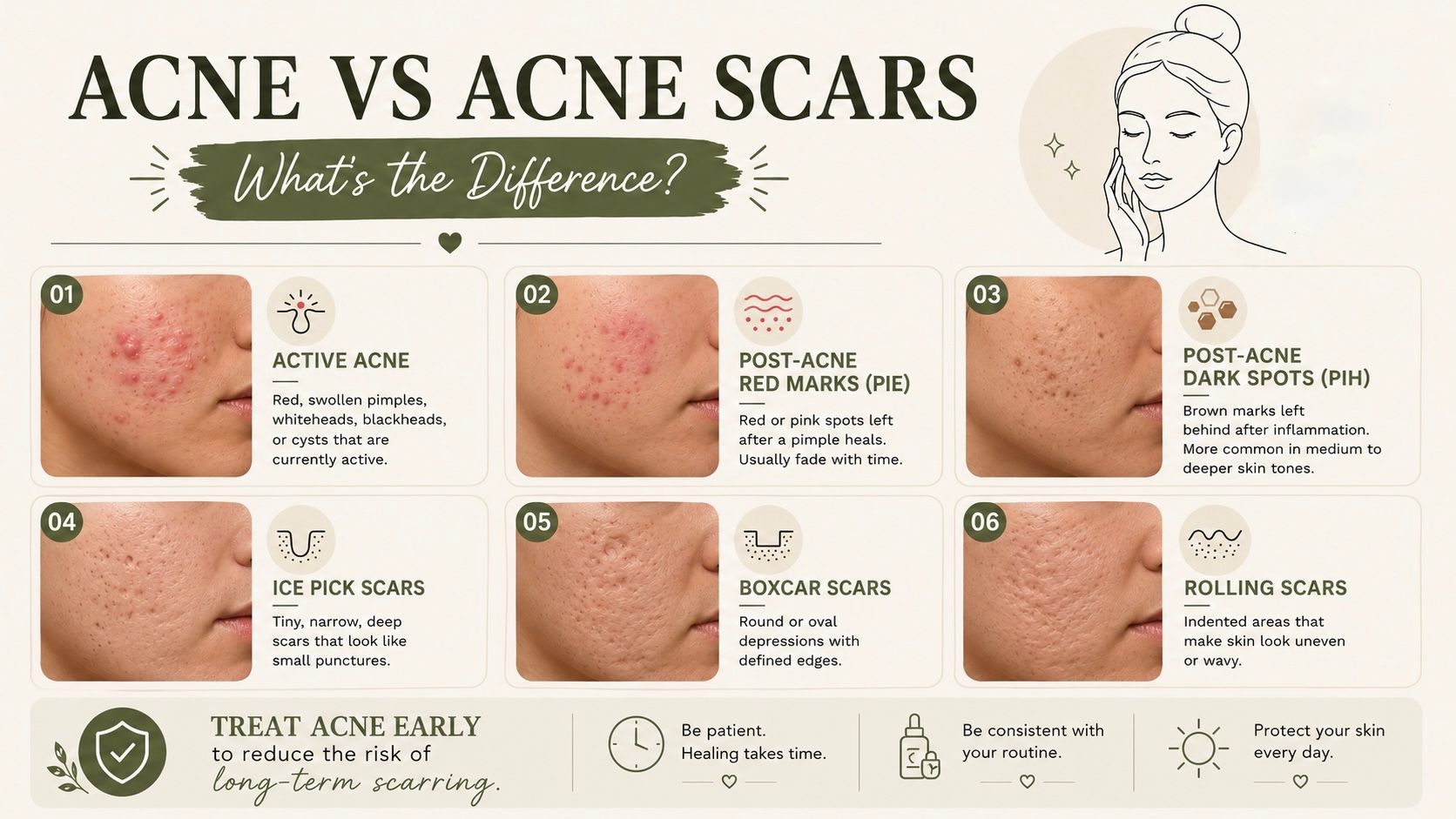
The main depressed acne-scar patterns are:
Rolling Scars
Rolling scars are broad, relatively shallow depressions that create an undulating or wave-like texture. They commonly develop when fibrous strands beneath the skin pull the surface downward.
Some rolling scars become less visible when the skin is stretched. Others remain fixed because they are strongly tethered to deeper tissue.
Rolling scars often respond poorly to resurfacing alone when the underlying fibrous attachments have not been released.
Boxcar Scars
Boxcar scars are round or oval depressions with more clearly defined edges. They can be shallow or deep.
Shallow boxcar scars may respond to fractional resurfacing or RF microneedling. Deeper boxcar scars with sharply defined borders may require more focused procedures such as punch elevation, punch excision or carefully selected combination treatment.
Ice-Pick Scars
Ice-pick scars are narrow at the surface but extend deeply into the skin. They may resemble enlarged pores, although they are usually deeper and more sharply defined.
Because the opening is narrow and the scar extends vertically, broad surface treatments may not reach the full depth of an ice-pick scar. TCA CROSS or punch excision may therefore be considered.
Tethered Scars
“Tethered” describes how a scar behaves rather than only how it looks.
A tethered scar is anchored downward by fibrous bands beneath the skin. During examination, the dermatologist may stretch or move the surrounding skin to determine whether the depression remains fixed.
Tethered scars frequently need a release procedure such as subcision before resurfacing or filler treatment can produce a meaningful result.
Pigmented Acne Marks
Brown, grey or red marks after acne are frequently called scars, but many are actually flat colour changes rather than structural scars.
These may include:
- Post-inflammatory hyperpigmentation
- Post-inflammatory erythema
- Persistent redness
- Mixed pigmentary changes
Pigmentation requires a different treatment strategy from depressed scarring. Treating a pigment problem as though it were a deep structural scar can expose the skin to unnecessary procedural risk.
Raised Acne Scars
Raised scars occur when the skin produces excessive scar tissue. These include hypertrophic scars and keloids.
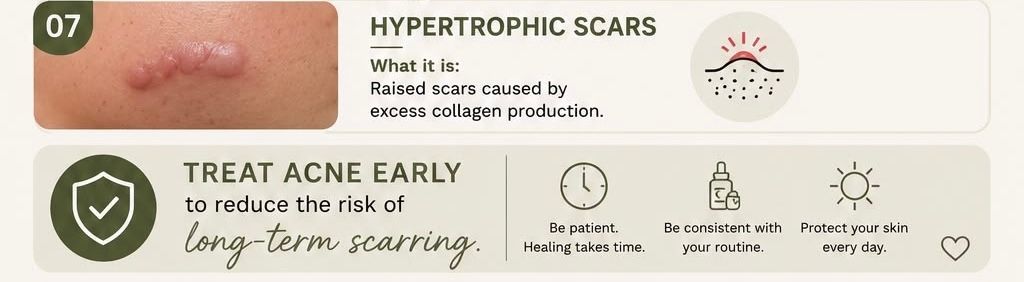
Raised acne scars are more common on the jawline, chest, shoulders and upper back. They may also be more common or more clinically significant in patients with darker skin tones.
Raised scars should not be treated in the same way as depressed scars. Fillers, aggressive needling or subcision would usually be unsuitable and could potentially worsen the problem.
Why Doesn’t One Laser Treat Every Acne Scar?
A laser can remodel collagen and improve surface texture, but it cannot correct every component of every scar.
For example:
- A laser may soften the edges of a boxcar scar.
- It may improve shallow textural irregularity.
- It may stimulate collagen remodelling in selected atrophic scars.
- It may not fully release a rolling scar that is physically anchored to deeper tissue.
- It may not adequately reach the narrow base of a deep ice-pick scar.
- It cannot treat a raised keloid scar using the same settings used for depressed scars.
This is why a machine-led approach can produce disappointing results. The treatment plan should begin with the diagnosis of the scar, not with the name of the device.
A fractional CO₂ laser is a valuable tool, but it is one tool within a broader acne-scar strategy.
What Is the Difference Between Rolling, Boxcar and Ice-Pick Scars?
The difference is mainly the scar’s width, depth, border and attachment to the deeper tissue.
| Scar type | Width | Depth | Edges | Common underlying issue |
|---|---|---|---|---|
| Rolling | Broad | Usually shallow to moderate | Soft and sloping | Fibrous tethering beneath the skin |
| Boxcar | Medium to broad | Shallow or deep | More vertical and defined | Localized tissue loss |
| Ice-pick | Very narrow | Deep | Sharply defined opening | Deep vertical tract |
A patient may have all three types simultaneously. For that reason, a dermatologist may divide the face into treatment zones rather than using one setting or one technique across the entire face.
Is Subcision Better Than Fractional CO₂ Laser?
Neither treatment is universally “better.” They treat different anatomical problems.
Subcision is used to release fibrous bands pulling a scar downward. It is particularly relevant for rolling and tethered scars.
Fractional CO₂ laser creates controlled columns of thermal injury within the skin. This stimulates healing, collagen remodelling and surface textural improvement.
Subcision may be more important when the main problem is deep tethering. Fractional CO₂ may be more useful when the primary problem is superficial-to-moderate textural irregularity, scar edges or general skin resurfacing.
For some patients, the treatments are complementary:
- Control active acne.
- Release selected tethered scars with subcision.
- Allow appropriate healing.
- Improve remaining texture with fractional CO₂ laser or RF microneedling.
- Reassess any persistent individual depressions.
- Consider focal treatment or conservative filler support where appropriate.
Subcision also has risks, including bruising, swelling, bleeding, temporary tenderness, haematoma, unevenness, infection and injury to deeper structures. It should be performed by a clinician who understands facial anatomy and scar depth.
When Is TCA CROSS Appropriate?
TCA CROSS means trichloroacetic acid chemical reconstruction of skin scars.
A high-concentration acid is applied very precisely inside an individual scar rather than spread over the entire face. The controlled chemical injury stimulates remodelling within the scar.
TCA CROSS is most often considered for:
- Ice-pick scars
- Narrow, deep boxcar scars
- Selected enlarged, scar-like pores
It is not the first choice for broad rolling scars or scars caused mainly by deep tethering.
Several sessions are often required. Temporary whitening, crusting and redness are expected. In Middle Eastern and darker skin tones, treatment must be conservative because post-inflammatory hyperpigmentation can occur.
TCA CROSS should not be attempted at home. Incorrect application can cause burns, prolonged pigmentation, widening of the scar or permanent injury.
When Is RF Microneedling Appropriate for Acne Scars?
Radiofrequency microneedling delivers energy into the dermis through insulated or non-insulated needles, depending on the device.
It may be considered for:
- Mild-to-moderate rolling scars
- Shallow boxcar scars
- General uneven texture
- Patients requiring a non-laser resurfacing option
- Selected darker skin types when an appropriately conservative protocol is used
RF microneedling can stimulate dermal remodelling while limiting some of the surface thermal exposure associated with ablative lasers. However, it is not risk-free.
Excessive depth, energy or repeated passes may cause prolonged inflammation, post-inflammatory pigmentation, track marks, burns, fat loss or worsening of texture.
RF microneedling may improve tethered scars to a degree, but pronounced fibrous anchoring may still require subcision.
When Is Fractional CO₂ Laser Appropriate?
Fractional CO₂ laser may be appropriate for:
- Shallow boxcar scars
- Some rolling scars after tethering has been addressed
- Rough or irregular texture
- Scar-edge softening
- Selected enlarged pores
- Overall resurfacing in appropriately selected patients
The laser removes microscopic columns of tissue while leaving surrounding skin available to support healing. This controlled injury stimulates collagen remodelling over the following months.
Fractional CO₂ laser should be individualized according to:
- Skin phototype
- Scar depth
- Treatment density
- Energy
- Pulse characteristics
- Number of passes
- Treatment area
- Previous pigmentary reactions
- Recent tanning or sun exposure
- Ability to follow post-treatment care
More aggressive settings do not automatically produce better results. In skin prone to pigmentation, excessive inflammation may create a new problem while attempting to improve the original scar.
Can Radiesse Help Depressed Acne Scars?
Radiesse is a calcium hydroxylapatite, or CaHA, injectable.
CaHA has both a physical support effect and a collagen-stimulating effect. Published studies suggest that CaHA may improve selected atrophic acne scars, including when used in diluted protocols or combined with other treatments.
However, the evidence base for CaHA in acne scars is smaller than the evidence supporting established treatments such as fractional lasers, microneedling, radiofrequency devices, TCA CROSS and subcision.
For this reason, CaHA treatment of acne scars should be presented as a selected or emerging application, not as a universal first-line treatment.
In my clinical work, diluted CaHA may be considered in carefully selected patients after evaluating:
- Whether the scar is tethered
- Whether the tether should first be released
- Skin thickness
- The depth and distribution of the scars
- Previous filler treatments
- Risk of nodules or uneven product placement
- Whether generalized dermal support would add value
CaHA is not appropriate for every scar, every anatomical area or every skin type. Precise dilution, plane, volume and distribution are important.
Can Hyaluronic-Acid Filler Help Depressed Acne Scars?
Hyaluronic-acid filler may help selected depressed scars by restoring support beneath the depression.
It may be appropriate for:
- A small number of persistent rolling or boxcar depressions
- Scars that improve when manually elevated
- Residual depressions after subcision
- Localized tissue loss
- Patients who prefer a reversible filler option
A filler should not simply be placed beneath a scar without assessing tethering. When a scar is firmly attached, adding filler without adequate release may create puffiness around the depression while leaving the centre anchored.
My preference is a conservative, anatomy-led approach. Where appropriate, a soft or biomimetic HA product may be used in small amounts to support the tissue without creating visible bulk or an overfilled appearance.
HA fillers have important risks, including bruising, swelling, infection, nodules, vascular occlusion and, very rarely, severe vascular complications. Treatment must be performed by an appropriately qualified medical practitioner.
Is Subcision Combined With Filler Better Than Subcision Alone?
Some depressed scars reattach during healing after subcision. A small amount of filler may help maintain space beneath the released scar and provide structural support.
However, not every subcised scar requires filler.
The decision depends on:
- The number and depth of scars
- The extent of tissue release
- Skin thickness
- Associated volume loss
- The likelihood of re-tethering
- Whether the planned filler is temporary, reversible or biostimulatory
- The patient’s tolerance for risk, swelling and cost
Conservative HA support may be useful when reversibility is important. Diluted CaHA may be considered in selected patients when broader dermal support or collagen stimulation is desired, although this remains a more specialized use with a smaller evidence base.
Can Acne Scars Be Completely Removed?
Acne scars can usually be improved, but they cannot reliably be erased completely.
The realistic goal is to make the scars:
- Shallower
- Softer at the edges
- Less visible in direct or overhead lighting
- More even in colour
- Less tethered
- Less noticeable in photographs and facial movement
The final degree of improvement depends on:
- Scar type
- Scar depth
- Duration of scarring
- Skin tone
- Active acne
- Collagen response
- Previous procedures
- Treatment choice
- Healing behaviour
- Sun exposure
- Willingness to complete a staged treatment plan
Patients should be cautious of claims promising “100% removal,” “glass skin in one session” or permanent elimination of deep acne scars.
How Many Acne-Scar Treatment Sessions Will I Need?
Most patients require a series of treatments rather than one session.
Approximate treatment ranges may include:
| Treatment | Common treatment course |
|---|---|
| Subcision | Often 1–3 sessions for selected tethered scars |
| Fractional CO₂ laser | Often 2–4 sessions |
| RF microneedling | Often 3–5 sessions |
| TCA CROSS | Often 3–6 focal sessions |
| Standard microneedling | Often 3–6 sessions |
| HA filler | May give immediate structural support; maintenance depends on product and area |
| Diluted CaHA | Often 1–3 sessions in selected protocols |
| Punch procedures | May be performed once or in stages for individual scars |
These are general estimates rather than guarantees.
Treatments are typically spaced several weeks or months apart to allow inflammation to settle and collagen remodelling to develop. Performing procedures too frequently can increase irritation and pigmentation without improving the final outcome.
Is Fractional CO₂ Laser Safe for Middle Eastern or Darker Skin?
Fractional CO₂ laser can be used in selected Middle Eastern and darker skin types, but it requires careful patient selection, conservative parameters and strict aftercare.
Saudi patients frequently have Fitzpatrick skin types III, IV or V. These skin types can heal well, but they may also develop post-inflammatory hyperpigmentation after excessive heat, inflammation or sun exposure.
Factors that may reduce risk include:
- Controlling active acne and skin irritation first
- Avoiding treatment on recently tanned skin
- Using individualized energy and density
- Avoiding unnecessary overlapping passes
- Preparing pigment-prone skin when appropriate
- Using broad-spectrum sunscreen consistently
- Avoiding direct sun and excessive heat after treatment
- Starting post-procedure pigmentation treatment only when medically appropriate
- Allowing sufficient healing time between sessions
The climate in Jeddah adds practical considerations. Strong ultraviolet exposure, heat, sweating and outdoor activity can make post-treatment care more challenging.
Fractional CO₂ laser is therefore not automatically the best first treatment for every patient with darker skin. In some cases, RF microneedling, non-ablative fractional treatment, subcision, focal techniques or a staged combination plan may offer a more appropriate risk-benefit balance.
What Is the Risk of Post-Inflammatory Hyperpigmentation?
Post-inflammatory hyperpigmentation, or PIH, is darkening that develops after skin inflammation or injury.
It is more common in medium-to-dark skin tones and may follow:
- Active acne
- Picking or squeezing spots
- Laser treatment
- RF microneedling
- Chemical reconstruction
- Aggressive peels
- Burns
- Infection
- Excessive post-procedure sun exposure
PIH can be temporary, but it may last for several months. In some patients it becomes more distressing than the original scar texture.
The risk cannot be reduced to zero, but it may be minimized through:
- Correct diagnosis
- Conservative procedural settings
- Appropriate pre-treatment skincare
- Daily broad-spectrum sunscreen
- Visible-light protection when pigmentation is present
- Gentle barrier-supportive aftercare
- Early recognition of excessive inflammation
- Avoidance of unnecessary treatment combinations
- Careful follow-up
A patient with active melasma, recent tanning or a history of prolonged pigmentation may require a modified treatment plan.
Why Must Active Acne Be Controlled Before Scar Treatment?
Treating acne scars while new inflammatory acne is still developing is similar to repairing a wall while it is still being damaged.
Active acne should be controlled first because:
- New breakouts may create new scars.
- Procedures can aggravate inflamed or infected lesions.
- Active inflammation increases the risk of pigmentation.
- The true scar pattern is easier to assess once acne has settled.
- Treatment time and cost may be wasted if scarring continues.
- Certain procedures may need to be delayed during or after particular acne medications.
Acne control may involve topical treatment, oral medication, hormonal assessment or isotretinoin when appropriate.
The timing of scar procedures during or after isotretinoin should be individualized. Modern evidence does not support one universal waiting period for every procedure, but aggressive fully ablative resurfacing and extensive surgery require particular caution. The treatment type, isotretinoin dose, healing history and skin characteristics must all be considered.
Should Pigmentation Be Treated Before Acne-Scar Texture?
Sometimes yes, but not always.
When a patient has significant active pigmentation, irritation or melasma, reducing pigment instability first may make procedural treatment safer.
However, some patients have both pigmentation and structural scars that can be treated in a coordinated sequence.
A possible staged plan may include:
- Control active acne.
- Stabilize the skin barrier.
- Begin pigmentation and sun-protection management.
- Identify tethered, ice-pick, boxcar and rolling scars.
- Treat the deepest structural problem first.
- Reassess before adding resurfacing.
- Continue pigment-prevention measures throughout recovery.
The sequence is determined by examination rather than by a fixed package.
Is Microneedling the Same as RF Microneedling?
No.
Traditional microneedling creates controlled mechanical channels using fine needles. RF microneedling adds radiofrequency energy at a selected depth.
Traditional microneedling may be useful for mild acne scars and general texture. RF microneedling may deliver more focused thermal remodelling within the dermis.
However, RF microneedling is not automatically superior. Results depend on:
- Needle depth
- Energy
- Number of passes
- Device design
- Scar type
- Skin thickness
- Treatment interval
- Operator experience
For deep ice-pick scars or strongly tethered rolling scars, neither traditional nor RF microneedling may be sufficient as a stand-alone treatment.
Do Acne-Scar Creams Work?
Creams cannot physically release a tethered scar or refill deep tissue loss.
Topical products may nevertheless help by:
- Controlling active acne
- Supporting collagen turnover
- Improving mild textural irregularity
- Reducing pigmentation
- Improving the skin barrier
- Preparing the skin for procedures
- Supporting recovery after treatment
Prescription retinoids may gradually improve acne, pigmentation and superficial texture. Sunscreen is essential for preventing scars and dark marks from becoming more visible.
Creams should be viewed as supportive treatment rather than a replacement for procedures when significant structural scarring is present.
Why Combination Treatment Often Produces Better Results
Most patients do not have only one type of scar.
A person may have:
- Tethered rolling scars on the cheeks
- Ice-pick scars near the temples
- Boxcar scars on the lower cheeks
- Post-inflammatory pigmentation along the jawline
- Active acne in the same region
Using fractional CO₂ laser over the entire face may improve some areas but leave others almost unchanged. A scar-specific plan may instead include:
- Subcision for tethered scars
- TCA CROSS for ice-pick scars
- Fractional CO₂ or RF microneedling for broader texture
- Conservative HA support for selected persistent depressions
- Diluted CaHA in selected cases requiring generalized dermal support
- Pigment-directed treatment and sun protection
- Ongoing acne control
Combination treatment does not mean performing every procedure on the same day. Staging treatments often allows the dermatologist to assess the response and reduce unnecessary inflammation.
Established Treatments Versus Emerging Treatments
Patients should understand the difference between treatments supported by broader clinical evidence and treatments that are promising but still supported by smaller studies.
More Established Options
Depending on the scar type, established or commonly accepted approaches include:
- Subcision for tethered rolling scars
- Fractional ablative and non-ablative lasers
- RF microneedling
- Traditional microneedling
- TCA CROSS for selected ice-pick scars
- Punch excision or punch elevation
- Selected dermal fillers
- Intralesional treatment for raised scars
- Combination treatment
Selected or Emerging Applications
These may have supportive evidence but generally require further high-quality comparative studies:
- Diluted CaHA for generalized atrophic acne scars
- Hybrid filler approaches
- Injectable biostimulatory products for scar remodelling
- Energy-device and biostimulator combinations
- Regenerative products marketed as exosomes
- Polynucleotides or PDRN as stand-alone scar treatments
- Platelet-derived products combined with resurfacing
Emerging does not mean ineffective. It means the quality, quantity or consistency of evidence is not yet equivalent to that of more established treatments.
Claims that exosomes, stem-cell products or injectable regenerative treatments can completely regenerate scarred skin should be treated cautiously.
What Happens During an Acne-Scar Consultation?
A proper acne-scar consultation should include more than looking at the skin under one light.
The assessment may include:
- History of active acne
- Previous isotretinoin use
- Previous laser or scar treatment
- Tendency to pigmentation
- History of keloids
- Current skincare and medication
- Examination under direct and angled lighting
- Stretch testing for tethered scars
- Assessment of skin thickness and laxity
- Photography
- Classification of individual scar types
- Discussion of downtime and risk
- Development of a staged treatment plan
Lighting is particularly important. Some scars appear mild under flat frontal lighting but become much more visible under overhead or side lighting.
Standardized photographs should therefore be taken using consistent lighting, distance, facial position and camera settings.
How Do I Choose an Acne-Scar Clinic in Jeddah?
Rather than asking only which machine the clinic has, consider asking:
- Who will diagnose my scar types?
- Do I have tethered scars?
- Is the treatment being selected for my scar pattern or offered as a package?
- What is the pigmentation risk for my skin tone?
- What result is realistic?
- Which scars are unlikely to respond?
- Will different areas of my face need different treatments?
- What complications can occur?
- Who will manage complications if they develop?
- How will my progress be photographed and assessed?
A credible treatment plan should explain not only what will be done, but also why that treatment has been chosen and what it cannot achieve.
A Practical Scar-Matching Treatment Framework
A simplified clinical framework may look like this:
Step 1: Control Active Acne
Prevent new scars and reduce inflammation.
Step 2: Separate Pigment From Structural Scarring
Determine whether the main concern is colour, texture or both.
Step 3: Identify Tethering
Rolling scars that remain fixed during stretch testing may require subcision.
Step 4: Treat Deep Focal Scars
Ice-pick and deep boxcar scars may require TCA CROSS or punch techniques.
Step 5: Improve General Texture
Fractional CO₂ laser, non-ablative fractional laser, microneedling or RF microneedling may be used according to skin type and scar pattern.
Step 6: Reassess Residual Depressions
Selected scars may benefit from conservative HA support or, in carefully chosen cases, diluted CaHA.
Step 7: Maintain Acne and Pigment Control
Daily sunscreen, suitable skincare and early treatment of new acne remain essential.
Final Takeaway
The most important question is not, “Which acne-scar machine is best?”
The better question is:
“Which structural problem is creating each scar, and which treatment addresses that problem with the lowest reasonable risk?”
Rolling, boxcar, ice-pick, tethered, pigmented and raised scars behave differently. One laser cannot treat them all equally.
For many patients, the most effective acne-scar treatment in Jeddah is a staged combination plan that controls active acne, releases tethering, treats deep focal scars, remodels broader texture and uses filler support only when the anatomy genuinely requires it.
Realistic treatment aims to improve scars—not promise their complete disappearance.
Frequently Asked Questions About Acne-Scar Treatment
What is the best treatment for rolling acne scars?
Rolling scars frequently have fibrous attachments beneath the skin. Subcision may be required to release these attachments. RF microneedling, fractional laser or conservative filler support may then be considered for remaining texture or depression.
Is subcision better than CO₂ laser for acne scars?
Subcision is generally more relevant for tethered rolling scars, while fractional CO₂ laser is used for surface remodelling and selected boxcar or textural scars. Many patients benefit from a staged combination rather than choosing one treatment exclusively.
Is TCA CROSS suitable for all acne scars?
No. TCA CROSS is most commonly used for narrow ice-pick scars and selected deep boxcar scars. It is generally less appropriate for broad rolling scars or raised scars.
Can RF microneedling remove deep acne scars?
RF microneedling can improve mild-to-moderate atrophic scars and overall texture, but it may not fully correct deeply tethered rolling scars or very deep ice-pick scars without additional targeted treatment.
Can fillers permanently remove acne scars?
No. Hyaluronic-acid fillers provide temporary structural support. Biostimulatory fillers may produce longer-term collagen changes, but they do not guarantee permanent scar removal. Fillers are most useful in carefully selected depressed scars.
Is Radiesse approved specifically for acne scars?
CaHA products such as Radiesse have been studied for atrophic acne scars, but acne-scar use may be considered off-label depending on the country and exact indication. The evidence is promising but more limited than for several established scar treatments.
How long do acne-scar results take to appear?
Filler support may be visible immediately, although swelling can affect the early appearance. Collagen-remodelling treatments such as subcision, fractional laser, RF microneedling and CaHA develop gradually over several weeks to months.
Can acne scars return after treatment?
A successfully remodelled scar does not usually return to its exact original state. However, new active acne can create new scars, and natural ageing or volume loss may make existing depressions more visible over time.
Is fractional CO₂ laser safe for brown skin?
It can be used in selected brown or Middle Eastern skin when parameters and aftercare are individualized. However, the risk of post-inflammatory hyperpigmentation is higher, so conservative treatment and strict sun protection are important.
How many acne-scar sessions are usually required?
Most patients need several sessions. The number depends on scar type, depth, skin tone, healing response and treatment method. A staged plan involving three or more treatment visits is common.
Can acne scars be treated while I still have acne?
It is generally better to control significant active inflammatory acne first. Otherwise, new scars may continue forming and procedures may increase inflammation or pigmentation.
What is the difference between acne scars and acne marks?
Acne scars involve a structural change such as a depression or raised scar. Acne marks are flat red, brown or grey areas caused by inflammation. Marks and scars require different treatments.
Need A Consult
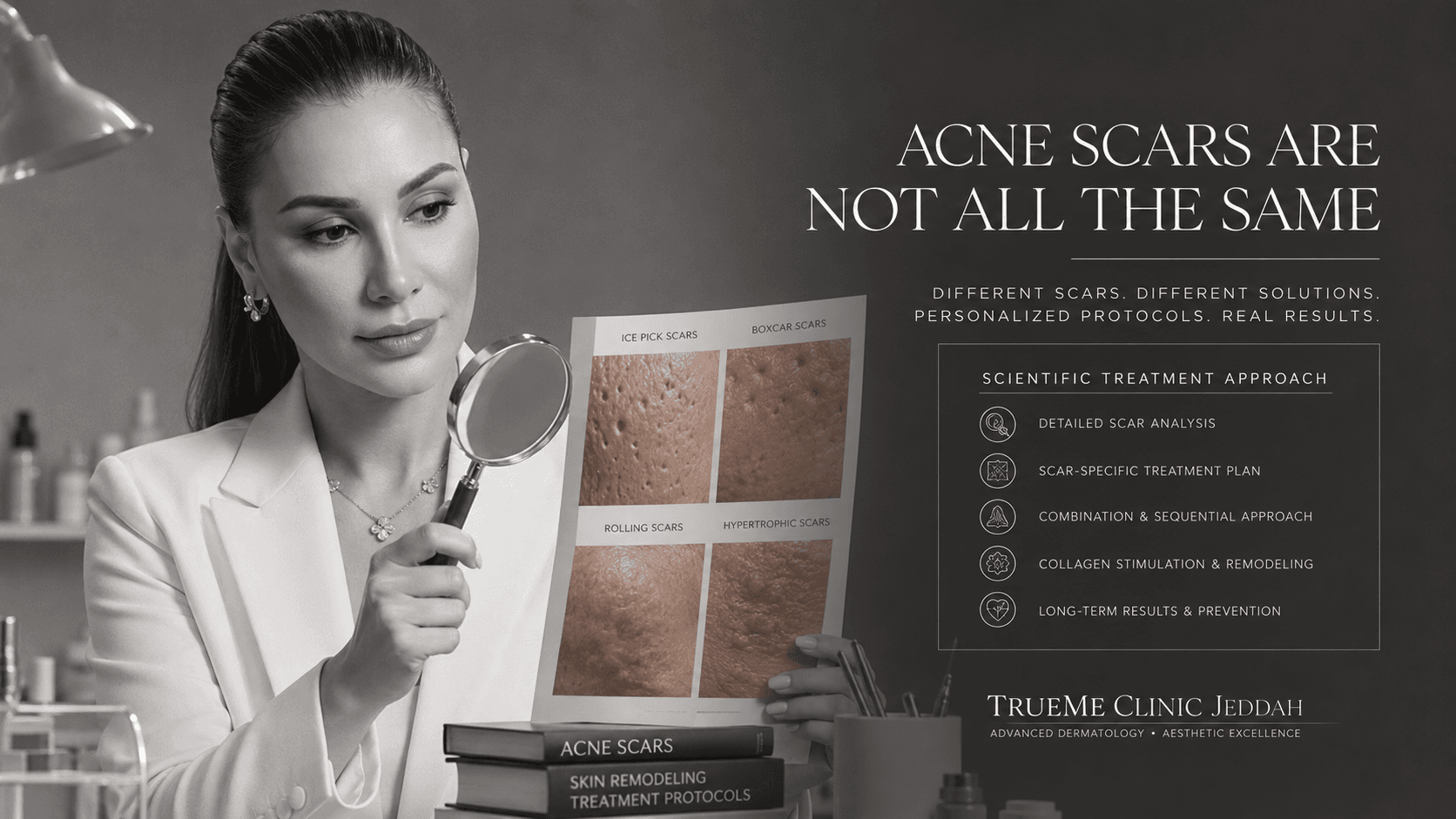
Which acne-scar treatment is right for you?
Let Dr. Shazia Ali explain your personalized acne scar treatment plan assessing rolling, boxcar, ice-pick and tethered scars.
What will work best for you? - Subcision, fractional CO₂ laser, RF microneedling, TCA CROSS and fillers.
Medical References
-
American Academy of Dermatology. Acne scars: Signs and symptoms.
-
American Academy of Dermatology. Scars: Signs and symptoms.
-
American Academy of Dermatology. Acne scars: Overview.
-
Gupta A, et al. Evidence-based surgical management of post-acne scarring in skin of color. Journal of Cutaneous and Aesthetic Surgery. 2020.
-
Salameh F, et al. Energy-based devices for the treatment of acne scars: International consensus recommendations. Lasers in Surgery and Medicine. 2022.
-
Ziebart RL, et al. Laser and energy treatments for acne scarring. Journal of Cosmetic Dermatology. 2024.
-
Zhang DD, et al. The efficacy of fractional CO₂ laser in acne-scar treatment: A meta-analysis. Dermatologic Therapy. 2021.
-
Ghazzawi R, et al. A systematic review evaluating the efficacy of fractional laser treatment for acne scars. Journal of Cosmetic and Laser Therapy. 2021.
-
Chilicka K, et al. Methods for the improvement of acne scars used in dermatology and cosmetology: A review. Journal of Clinical Medicine. 2022.
-
Casabona G, et al. Combined use of microfocused ultrasound and diluted calcium hydroxylapatite for treating atrophic acne scars. Journal of Cosmetic Dermatology. 2018.
-
Koren A, et al. Diluted calcium hydroxylapatite combined with an energy-based device for facial atrophic acne scars. Clinical and Experimental Dermatology. 2019.
-
Antonino A, et al. Calcium hydroxylapatite versus calcium hydroxylapatite combined with microfocused ultrasound for acne scars. Journal of Cosmetic Dermatology. 2021.
-
Mehrabi JN, et al. Comparison of two hyaluronic-acid-based fillers for the treatment of acne scars. Aesthetic Surgery Journal. 2023.